
Marilyn’s Dark Paradise is not just another film about Monroe. It is a time travel journey told in seven acts, but also a mirror of survival, identity, and what it means to keep going when everything around you tries to stop you.
Nearly a decade ago, my brother Tony was struck by a drunk driver and survived. When he woke from his coma, we had an honest conversation about time, about how fragile it is, and about the danger of waiting too long to follow through on the things you care about. That moment became the quiet beginning of this film.
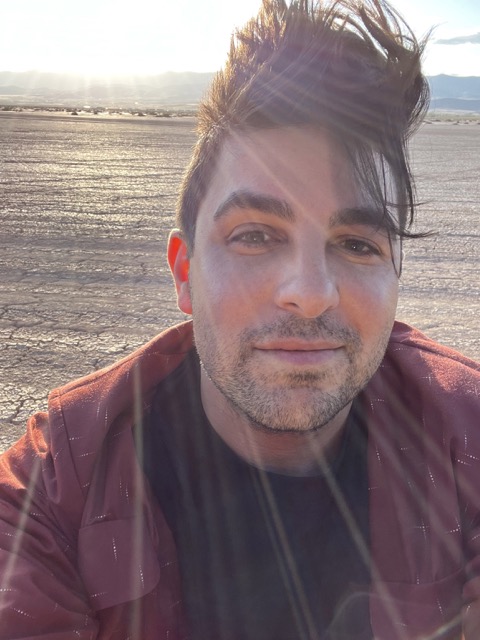
In an almost cruel twist of fate, just weeks before completing Marilyn’s Dark Paradise in 2025, I too was struck by a drunk driver. The accident was violent and life changing. What followed were surgeries, scars, and a long road of recovery. Still, I could not let the film go. I carried it forward piece by piece, thinking about a life constantly in the light, where resilience was born in the darkness.
That contradiction became the soul of the film. Marilyn lived in a paradise the world envied, defined by beauty, fame, glamour, and devotion. Yet that same paradise imposed control, isolation, exhaustion, and the gradual erosion of her sense of self. The attention that elevated her also confined her. The love was real, but conditional.
Finding the right person to portray Marilyn was the most difficult and important decision of the entire process. I searched for years for someone who could inhabit her with love while also carrying pain, perseverance, and survival within themselves. When Stephanie Stuart entered the project, it was immediately clear the search was over. As both the actress portraying Marilyn and a Producer on the film, her understanding of Marilyn was instinctive rather than performative, rooted in empathy instead of imitation. She brought emotional truth, strength, and care to the role, while also helping guide the film creatively at every stage, protecting Marilyn’s humanity on screen and behind the camera. There is no one else who could have made this film as the lead. I am grateful I waited long enough for our paths to align, and deeply honored to work alongside her in bringing Marilyn’s story to life.
Addelyn Workman portrays young Norma Jeane, capturing Marilyn during her time at the Los Angeles Orphans Home. Her performance holds the quiet contradictions of that period, the presence of a mother alongside the label of orphan, the simultaneous experience of being claimed and abandoned. In those moments, the earliest fracture of self begins to form. Addelyn brings an extraordinary stillness to the role, allowing innocence, confusion, and endurance to exist at once, revealing the first emotional truths of the woman Marilyn would become.
We worked closely with female historians, biographers, and consultants who helped ground the story with context. We also collaborated with Gary Vitacco-Robles in both a historical and producing capacity, drawing on his five-volume biography of Monroe, written with the insight of a licensed mental health professional, to ensure her story was approached with insight and responsibility.
We filmed in the places where she once stood, from Misfits Flat to Niagara Falls, Santa Monica Beach, and Los Angeles, because authenticity was essential to honoring her story. Through the gorgeous cinematography of Rob Watt, these locations are rendered with intimacy and reverence, capturing both the allure of the image and the quiet weight beneath it.
We wove in Marilyn’s personal belongings, preserved by historians and collectors since her passing, including pieces from the collection of Scott Fortner, whose lifelong dedication to safeguarding her legacy allowed history to remain tangible rather than abstract. Most importantly, we allowed her to be heard again. Through her song Kiss, mastered in Dolby Atmos, her voice does not simply return, it fills the space, surrounding the audience as if she has stepped back into the room and refuses to fade into memory.
The film is scored by award-winning composer Jason Pelsey, who created original music specifically for Marilyn’s Dark Paradise. His score carries a wide emotional range, moving between moments of exhilaration and moments of deep sorrow, often within the same breath. At times the music lifts, expansive and brilliant, capturing the thrill of possibility. At others it recedes into something quieter and more fragile, giving space to loneliness, longing, and reflection. Shaped over years of careful composition, the score becomes the emotional spine of the film, guiding the audience through Marilyn’s struggle with what it means to be, “enough”.
Marilyn’s 100th birthday in June of 2026 serves as a meaningful backdrop for the making of this film, reinforcing a responsibility to tell her story with care. Marilyn’s Dark Paradise began by looking beyond the image and listening more closely to the woman herself. In doing so, I came to better understand the quiet endurance that defined her life.
She was a legend, but was also profoundly human. She carried vulnerability and strength side by side, and through that duality left behind a legacy shaped not by perfection, but by endurance.
My own experiences do not mirror Marilyn’s, nor do they belong beside them. But working so intimately with her story while rebuilding my own life post-accident, deepened my respect for what she endured and what she continued to give the world despite it.
Marilyn’s Dark Paradise is, above all, Marilyn’s story. If it lingers after the credits, it is because her voice continues to echo across generations, radiant, resilient, and impossibly alive.
– Remi Gangarossa